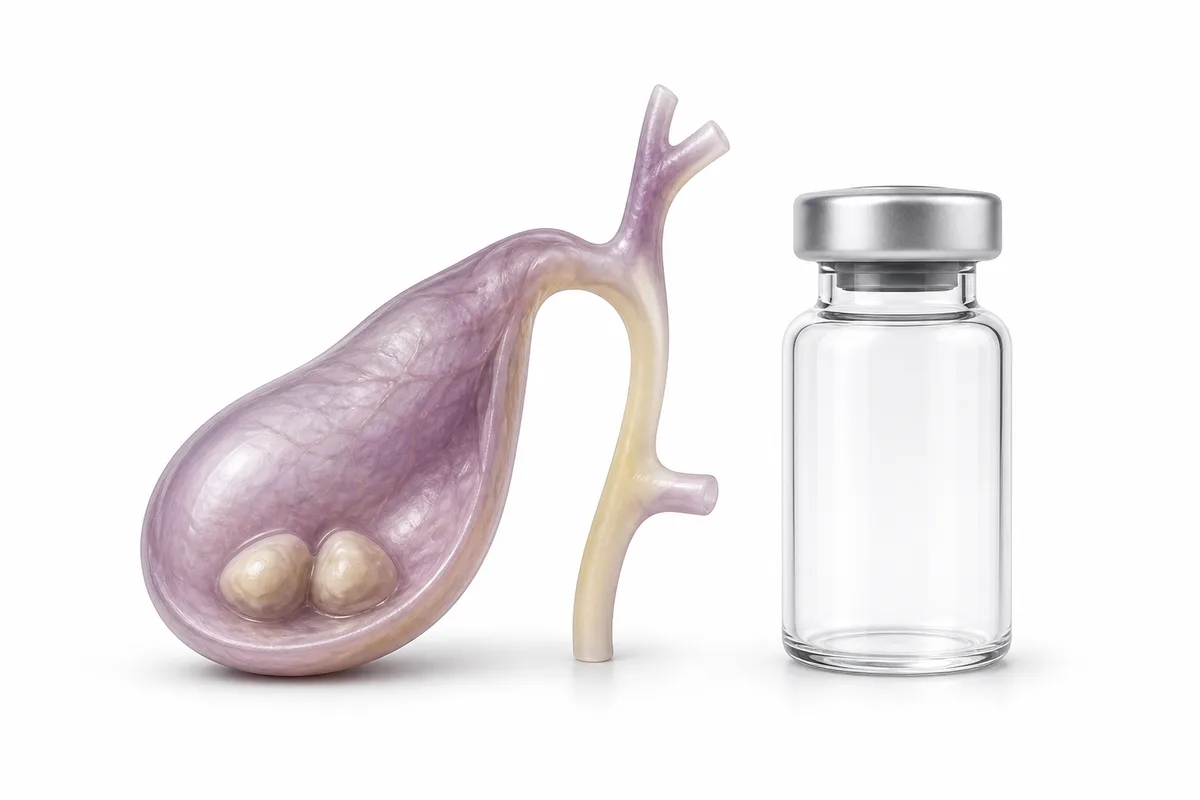
TL;DR: A steady, severe ache under your right ribs after a fatty meal is the classic gallbladder question, and GLP-1s do nudge the odds of gallstones up a bit. Two things are at play: rapid weight loss itself makes bile more stone-prone (the bigger lever), and GLP-1s can slow how well the gallbladder empties, so bile sits longer. It is a recognized but not common event. Most people never notice a thing. This piece covers why the risk exists, the warning signs worth knowing, and a few plain ways to keep the odds low.
If you have felt a sharp pain under your right ribs a few weeks into a GLP-1 and immediately wondered “is it my gallbladder?”, you are asking a reasonable question. The gallbladder-GLP-1 connection is real, it is well documented, and it is also easy to keep in proportion once you understand what is actually happening. This is a “know the signs” topic, not a scary one.
Why the risk goes up: two separate levers
There are two mechanisms behind the gallbladder story, and they are worth separating because they carry different weight.
The first, and the bigger one, is rapid weight loss itself. This is not unique to GLP-1s at all. Any fast fat loss, whether from bariatric surgery, a crash diet, or a medication, changes the chemistry of your bile. As the body mobilizes fat stores quickly, extra cholesterol gets dumped into bile, and it can overwhelm the bile acids that normally keep it dissolved. Bile becomes more “lithogenic,” which is just a technical way of saying more prone to forming stones. At the same time, when you are eating less, the gallbladder contracts less often, so bile pools instead of being flushed out regularly. Losing weight fast has always carried a higher gallstone risk. GLP-1s just happen to be very good at producing fast weight loss.
The second lever is more specific to the drug class. GLP-1s appear to reduce gallbladder motility directly. One proposed pathway is that they blunt the post-meal release of cholecystokinin (CCK), the hormone that tells the gallbladder to squeeze after you eat. Less CCK signaling means a lazier gallbladder, incomplete emptying, and bile that sits longer than it should. Stagnant bile is where sludge and stones like to form.
How big is the risk, really?
Proportion matters here, so let’s be concrete without overstating it. Pooled analyses do show a measurable signal: GLP-1 use is associated with a modestly higher relative risk of gallbladder and biliary events, on the order of roughly 1.3 to 1.5 times baseline in meta-analyses. That sounds like a lot until you look at the absolute numbers, which are small. One analysis translated the effect to something like a couple dozen extra events per 10,000 people per year. The relative bump is real; the everyday chance for any one person stays low.
The risk is not spread evenly across time. It tends to concentrate in the first 6 to 12 months and around the phase of fastest weight loss, which lines up neatly with the rapid-loss mechanism. Higher doses and longer duration also read as higher-risk in the data, again consistent with the idea that the amount and speed of weight change is doing most of the driving. If your loss has leveled off, you are generally past the steepest part of the curve. That plateau, frustrating as it can feel, is discussed in our weight-loss plateau piece, and it is not a bad thing for your gallbladder.
The warning signs worth knowing
This is the part people actually search for, so here it is plainly. A gallbladder attack (biliary colic) has a fairly recognizable pattern, and it does not feel like ordinary GLP-1 nausea or the general queasiness covered in GLP-1 side effects management.
The distinguishing features are that the pain is constant and intense rather than crampy and fleeting, it often follows food, and it lingers. A brief twinge that comes and goes in seconds is usually something else. A steady 45-minute vise under the right ribs after a rich dinner is the pattern that deserves attention.
If biliary-type symptoms show up, that is a straightforward “pause the dose and get it checked, usually with an ultrasound” situation rather than something to push through.
Practical ways to keep the odds low
None of this is prescriptive, and none of it is medical advice, but there are a few well-understood factors that push the risk in your favor.
- Slower loss beats faster loss. Because the speed of weight loss is the main lever, a gentler titration and a more gradual rate of loss tend to be easier on the gallbladder. The dosing arithmetic behind that is in the semaglutide and tirzepatide titration guides.
- Do not crash the fat down to zero. This one surprises people: eating some dietary fat actually helps, because fat is the signal that makes the gallbladder contract and empty. Very-low-fat crash dieting leaves the gallbladder idle and the bile stagnant, which is worse for stones, not better. A moderate amount of fat keeps things moving.
- Stay hydrated. Ordinary, unglamorous, and genuinely helpful for bile that is already prone to sludging.
- Ursodeoxycholic acid (a bile acid also called ursodiol) is used in some clinical settings during periods of rapid weight loss specifically to lower gallstone formation. Mentioning it as a known approach, not as a recommendation, because it belongs in a conversation with a clinician rather than a self-experiment.
Where this fits in the bigger picture
The gallbladder is one node in how GLP-1s reshape metabolism, and it is worth keeping the whole map in view. The same rapid fat loss that stresses the gallbladder is, for many people, resolving fatty liver and quieting the food noise that drove the weight on in the first place. The trade-off is not lopsided. A short window of somewhat higher gallstone risk sits alongside broad metabolic gains, and the risk window itself narrows as loss slows.
It is also worth knowing that stopping a GLP-1 and regaining weight, then losing it again, means re-entering the fast-loss window more than once. That cycling is one more reason the maintenance and regain conversation matters, since a steady weight is a settled gallbladder.
The honest bottom line: the large majority of people on a GLP-1 never have a gallbladder problem at all. This is not a reason to be anxious every time you feel a twinge. It is simply worth knowing the one pain pattern, upper-right, steady, severe, after food, lasting a while, that is worth acting on if it ever shows up. Recognize it if it happens, and otherwise carry on.
Frequently asked questions
Is pain under my right ribs on a GLP-1 always my gallbladder?
Not always, but it is the right thing to consider. The gallbladder-attack pattern is fairly specific: steady, severe upper-right or upper-central pain, often after a fatty meal, lasting 30 minutes or more, sometimes radiating to the right shoulder or back. General GLP-1 nausea and vague upper-belly discomfort are more common and usually feel different. If the pain matches the attack pattern, especially with vomiting, fever, or yellowing, it is worth getting checked with an ultrasound rather than waiting it out.
Do GLP-1s cause gallstones, or is it the weight loss?
Mostly the weight loss, with a smaller contribution from the drug itself. Any rapid fat loss makes bile more prone to forming stones and slows how often the gallbladder empties, and that accounts for the bulk of the risk. GLP-1s add a second factor by directly reducing gallbladder motility, partly through blunted CCK signaling after meals. Both effects push in the same direction, but the speed and amount of weight loss is the bigger lever.
When is the gallstone risk highest?
The risk concentrates in the first 6 to 12 months and around the phase of fastest weight loss, which fits the rapid-loss mechanism. Higher doses and longer treatment also read as somewhat higher risk in pooled data. Once your weight loss levels off into a plateau or maintenance, you are generally past the steepest part of the risk curve.
Should I eat low-fat to protect my gallbladder?
Counterintuitively, no, not extremely low-fat. Dietary fat is what signals the gallbladder to contract and empty, so a moderate amount actually helps keep bile moving. Very-low-fat crash dieting leaves the gallbladder idle and the bile stagnant, which is a classic setup for stones rather than a protection against them. Moderation, not elimination, is the friendlier approach.
Do I need to stop my GLP-1 if I get gallbladder symptoms?
If clear biliary symptoms appear, the sensible move is to pause the dose and get it evaluated, typically with an ultrasound, rather than pushing through. That is not the same as abandoning the medication for good; it is a check-and-confirm step. Whether and how to resume is a conversation to have with a clinician once the cause of the pain is known.
References
- He L, Wang J, Ping F, et al. Association of Glucagon-Like Peptide-1 Receptor Agonist Use With Risk of Gallbladder and Biliary Diseases: A Systematic Review and Meta-analysis. JAMA Internal Medicine. 2022;182(5):513-519. doi:10.1001/jamainternmed.2022.0338
- Nauck MA, Quast DR, Wefers J, Meier JJ. GLP-1 receptor agonists in the treatment of type 2 diabetes – state-of-the-art. Molecular Metabolism. 2021;46:101102. doi:10.1016/j.molmet.2020.101102
- Wilding JPH, Batterham RL, Calanna S, et al. Once-Weekly Semaglutide in Adults with Overweight or Obesity. New England Journal of Medicine. 2021;384(11):989-1002. doi:10.1056/NEJMoa2032183
- Stinson SE, et al. GLP-1 receptor agonists and gallbladder disease risk: molecular mechanisms and clinical implications. PMC. 2025. PMC12739101.
- Erlinger S. Gallstones in obesity and weight loss. European Journal of Gastroenterology and Hepatology. 2000;12(12):1347-1352.
Research use only. This article explains gallbladder and gallstone concepts in the context of GLP-1 research for laboratory and educational purposes. It is not medical advice and does not recommend any dose, protocol, or human use. If you are experiencing acute abdominal pain, that is a matter for a qualified clinician. Handle all research materials in accordance with applicable EU regulations and institutional guidance.