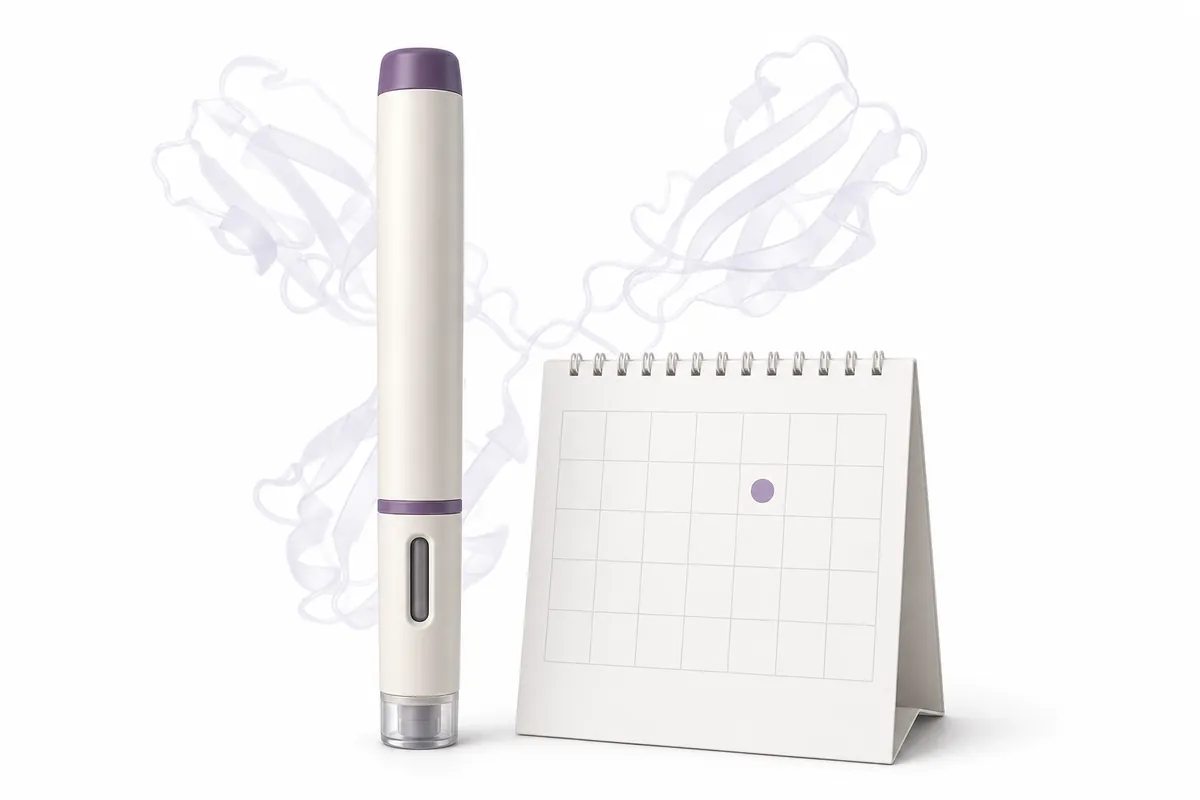
TL;DR: MariTide (maridebart cafraglutide, Amgen’s AMG 133) is an obesity injectable that breaks two of the field’s default assumptions at once. First, it’s dosed once a MONTH, not once a week like semaglutide or tirzepatide. Second, it runs the GIP arm backwards: it AGONIZES the GLP-1 receptor while ANTAGONIZING (blocking) the GIP receptor — the opposite GIP direction from tirzepatide, which agonizes GIP. Mechanically it isn’t a simple peptide either; it’s a peptide-antibody conjugate, with two GLP-1 peptides grafted onto a GIP-receptor-blocking monoclonal antibody. In a Phase 2 trial published in the New England Journal of Medicine in June 2026, the highest doses produced up to roughly 20% weight loss at 52 weeks, with no weight-loss plateau observed at the 52-week mark. The six-study Phase 3 MARITIME program is now enrolling, with the MARITIME-1 readout expected in early 2027.
The headline: monthly dosing, and GIP pointed the other way
Almost every incretin drug that matters right now shares two design choices. They’re dosed weekly, and where they touch the GIP receptor at all, they activate it. Tirzepatide is the clearest example — a dual agonist that switches on both the GLP-1 and GIP receptors once a week. MariTide keeps the GLP-1 agonism but does the other two things differently: it blocks the GIP receptor instead of activating it, and it’s engineered to be injected roughly once a month rather than once a week.
That combination is unusual enough that it’s worth slowing down on both halves, because each one is a genuine departure from how the current generation of obesity drugs is built.
What MariTide actually is, mechanically
Here’s the part that gets glossed over most often: MariTide is not a simple peptide. Semaglutide and tirzepatide are peptides — chains of amino acids, dosed weekly because acylation and albumin binding stretch their half-lives out to about a week. MariTide is built on a different chassis entirely. It’s a peptide-antibody conjugate: a monoclonal antibody that antagonizes the GIP receptor, with two GLP-1 receptor-agonist peptides chemically bonded onto it. One molecule, two jobs, but the scaffold doing most of the pharmacokinetic work is an antibody, not a peptide.
That architecture is the reason monthly dosing is even on the table. Monoclonal antibodies natively circulate for weeks — that’s how antibody drugs in other fields get away with monthly or quarterly injections — so hanging the GLP-1 agonist peptides off an antibody backbone lets MariTide inherit that long residence time. A conventional acylated peptide can’t easily reach a month; an antibody conjugate can.
The GIP paradox: how can agonizing and antagonizing both cause weight loss?
This is the question that trips everyone up, and it’s a fair one. Tirzepatide activates the GIP receptor and produces excellent weight loss. MariTide blocks the GIP receptor and also produces weight loss. Both directions can’t be “the right one” in a simple story — so what’s going on?
The honest answer is that the field doesn’t have a fully settled mechanistic explanation, and the two leading hypotheses genuinely disagree. One line of thinking holds that sustained GIP-receptor agonism eventually desensitizes the receptor, so a strong agonist ends up functionally behaving a bit like a blocker over time — meaning the two approaches might converge on a similar downstream state. The competing view is that GIP antagonism acts through a distinct central pathway on appetite and energy balance that doesn’t depend on that desensitization argument at all. What’s clear from the clinical data is empirical rather than theoretical: in trials, both the agonist and the antagonist approach, each paired with GLP-1 agonism, have driven substantial weight loss. MariTide’s job is to test the antagonist side of that bet at scale.
That’s the intellectually interesting thing about MariTide as a research object — it’s a large, well-powered test of a mechanism that runs opposite to the current market leader, rather than another entry pointed the same way.
The Phase 2 data: up to ~20% at 52 weeks, no plateau yet
The pivotal early readout landed in the New England Journal of Medicine in June 2026 (PMID 40549887). The Phase 2 trial tested MariTide across a range of monthly doses in adults with obesity, some with and some without type 2 diabetes, over 52 weeks. At the higher doses, participants without diabetes reached up to roughly 20% mean weight loss by week 52 — a magnitude that puts it in the same neighborhood as the strongest weekly injectables, reached on a monthly schedule.
The detail that drew the most attention wasn’t the peak number, though — it was the shape of the curve. At 52 weeks, the weight-loss trajectory had not visibly flattened. Most incretin trials show a plateau somewhere in the first year, where the curve bends toward horizontal as loss and adaptation reach balance. In this Phase 2 readout, no weight-loss plateau was observed at the 52-week mark, which raises the open question of how much further the curve might have gone with more time. That’s a hypothesis-generating observation, not a settled endpoint — the plateau could simply arrive later — but it’s the reason the readout was treated as notable rather than routine.
Illustrative curve based on the direction and magnitude reported in the NEJM June 2026 Phase 2 readout (PMID 40549887), higher-dose participants without diabetes. Note the trajectory had not plateaued at week 52. Research data, not a human protocol.
Participants with type 2 diabetes lost somewhat less than those without — the attenuated weight-loss response in diabetes is a pattern that shows up across the whole incretin class, not something specific to MariTide. Gastrointestinal side effects, chiefly nausea and vomiting, were the most common tolerability issue, again consistent with the category; dose titration is one of the levers the Phase 3 program is expected to use to manage that.
Monthly vs. weekly: why the cadence matters
The efficacy headline is the ~20%, but for a lot of people the more practically interesting number is 12 versus 52 — roughly a dozen injections a year instead of one every week. Real-world adherence to injectable GLP-1 therapy consistently lags behind what trials achieve, and a chunk of that gap traces to the simple friction of a recurring weekly task. A monthly cadence attacks that friction directly: fewer injections, fewer missed doses, less of the weekly logistics that quietly erode persistence over months.
Dosing cadence only — not a comparison of efficacy or tolerability. Approximate annual injection count at steady maintenance.
The trade-off is that monthly dosing concentrates each dose’s pharmacology into a less frequent pulse, which is part of why titration and GI tolerability get so much attention in a monthly regimen — you can’t smooth exposure the way a shorter interval allows. Whether the adherence advantage of monthly dosing outweighs the tolerability-management challenge is exactly the kind of question a large Phase 3 program is built to answer.
MARITIME: the Phase 3 program now enrolling
MariTide has moved into a six-study Phase 3 program called MARITIME, which is now enrolling across obesity and related indications. The lead study, MARITIME-1, is the one to watch first: its readout is expected in early 2027, and it’s the trial that will translate the Phase 2 signal — the magnitude, the durability, and the tolerability profile — into the larger, longer dataset that regulatory decisions rest on.
Until then, MariTide sits in the same category as the other headline names still working through late-stage trials: a compound with a striking Phase 2 result and a genuinely differentiated mechanism, but not an approved product. The Phase 2 numbers are a signal, not a finish line, and the no-plateau observation in particular is the kind of thing that either holds up or softens once a bigger population and longer follow-up are in hand.
For where MariTide sits against the rest of the emerging field, our next-gen weight loss peptides overview maps the wider pipeline, and the retatrutide vs. tirzepatide comparison covers how the multi-receptor incretins line up against the current dual-agonist standard.
Frequently asked questions
Is MariTide a peptide?
Not a simple one. MariTide is a peptide-antibody conjugate: two GLP-1 receptor-agonist peptides are chemically bonded onto a monoclonal antibody that blocks the GIP receptor. So it contains peptides, but the molecule as a whole is an antibody conjugate, not a classic peptide like semaglutide or tirzepatide — and that antibody scaffold is what makes once-monthly dosing possible.
How is MariTide different from tirzepatide?
Both agonize the GLP-1 receptor and both engage the GIP receptor, but in opposite directions. Tirzepatide is a GIP agonist (it switches the GIP receptor on); MariTide is a GIP antagonist (it blocks it). MariTide is also dosed roughly once a month, while tirzepatide is dosed once a week, and the two are built on different molecular scaffolds — a peptide for tirzepatide, a peptide-antibody conjugate for MariTide.
How can blocking GIP and activating GIP both cause weight loss?
This is an open mechanistic question, not a settled one. One hypothesis is that sustained GIP-receptor agonism eventually desensitizes the receptor, so a strong agonist may end up behaving somewhat like a blocker over time. A competing view is that GIP antagonism works through a distinct pathway on appetite and energy balance. What the clinical data show empirically is that both approaches, each paired with GLP-1 agonism, have produced substantial weight loss in trials.
How much weight loss did MariTide produce in trials?
In the Phase 2 trial published in the New England Journal of Medicine in June 2026 (PMID 40549887), the higher monthly doses produced up to roughly 20% mean weight loss at 52 weeks in participants with obesity and without diabetes. Notably, no weight-loss plateau was observed at the 52-week mark, leaving open how much further the curve might have continued.
How often is MariTide injected?
About once a month. That monthly cadence is one of MariTide’s main points of differentiation from weekly injectables like semaglutide and tirzepatide, and it’s made possible by the antibody scaffold the molecule is built on, which circulates for weeks at a time.
Is MariTide approved, and when will Phase 3 results come out?
No, MariTide is not approved. It’s in a six-study Phase 3 program called MARITIME, which is now enrolling. The lead study, MARITIME-1, has a readout expected in early 2027 — that’s the dataset that will test whether the Phase 2 signal, including the no-plateau observation, holds up at scale.
References
- Maridebart Cafraglutide (MariTide) for Weight Management in Adults with Obesity. New England Journal of Medicine. June 2026. PMID 40549887.
- Amgen. “Amgen advances MariTide (maridebart cafraglutide) into the Phase 3 MARITIME program.” Company announcement, 2026.
- Véniant MM, et al. A GIPR antagonist conjugated to GLP-1 analogues promotes weight loss with improved metabolic parameters in preclinical and phase 1 settings. Nature Metabolism / Amgen research disclosures.